Player Comparison

Analysis: How five elite scorers get their goals by Guest User

kuch.jpeg

By Owen Kewell

There’s something beautiful about scoring a goal.

Goals are the building blocks that make up hockey success, both on the individual and team level. They are a single moment in time, a culmination of a series of plays that ends with one team’s attack successfully defeating the other’s defense.

Teams are forever searching to add goals to their lineup, and for good reason. Goals win games, playoff series and, eventually, championships.

Goal-scoring is a repeatable talent, and while certain NHLers are far better at it than others, each player does it their own way. Each scorer exhibits unique tendencies of shot type selection and shot location.

Alex Ovechkin, Evgeni Malkin, Connor McDavid, Nikita Kucherov, and Patrik Laine are five of the best scorers in the game. Of the 10 goal leaders for the 2017-18 season, these five players possess the highest career goals per game rates. They are the elite of the elite when it comes to putting the puck into NHL nets.

I wanted to explore how they each do it differently.

Elite Scorers 1.jpg

The above visualization separates by shot type to show how each player scored their goals in the 2017-18 season. Overall, the most popular shot type was wrist shot, followed by snap shot, slap shot, and finally backhand.

It should be noted that the ‘AVG (10+ G Forwards)’ represents a weighted average of the relevant shot rate among all forwards who scored 10 or more goals, weighted by the number of goals that they scored. It’s a way to quantify ‘normal’ rates for the league’s goal scoring forwards.

Let’s take a more detailed look at each of these five players.

Alex Ovechkin

Elite Scorers 3.jpg

It’s no secret that Alex Ovechkin is really good at scoring goals. Since breaking into the league, he’s won the scoring title 7 times and no one else has won it more than twice. Sitting at 607 career goals, Ovi continues to propel himself further up the list of all-time greats. His 0.605 goals per game ranks first league-wide, beating out all other forwards by at least 0.08 G/GP.

Ovechkin loves slap shots, which should come as no surprise to anyone who’s watched Washington’s power play operate. His 17 slap shot goals were an uncontested 1st league-wide, with Steven Stamkos being the only other forward to score more than 7. Ovechkin’s slap shot is so powerful that it beats goalies clean even whey they know it’s coming, meaning that it can be unleashed without needing to be disguised.

Equally noteworthy, Ovechkin scored just 31% of his goals by wrist shot, which represents the lowest rate among all 32 players who scored 30+ goals.

Heat Map courtesy of Micah Blake McCurdy's website HockeyViz (https://hockeyviz.com)

Heat Map courtesy of Micah Blake McCurdy's website HockeyViz (https://hockeyviz.com)

The red areas in the above heat map show where Ovechkin shoots more frequently than the rest of the league. Ovechkin makes an absolute killing at the top of the left faceoff circle, often referred to as the ‘Ovi Spot’. This area lines up with Ovechkin’s average shot distance of 32.3 feet, which ranked in the 80th percentile among the league’s forwards.

Although it’s not reflected in the heat map, much of Ovechkin’s damage is done with the man advantage playing the left point. Of his 49 goals, 17 were scored on the power play, which ranked 2nd only behind a player further down this list. His remaining 32 were scored at even-strength, which again ranked 2nd in the league. Elite scoring across both special teams and even-strength situations throughout his career has propelled Ovechkin to the status of the league’s premier goal scorer.

Evgeni Malkin
Elite Scorers 5.jpg
Elite Scorers 6.jpg

Despite being the second-best player on his team, Malkin has put together the resume of an elite goal scorer. He’s scored 75 goals in 140 games over the past two seasons, which converts to 44 goals over an 82-game season. His career goals per game of 0.472 ranks 6th among active forwards, placing him in elite company.

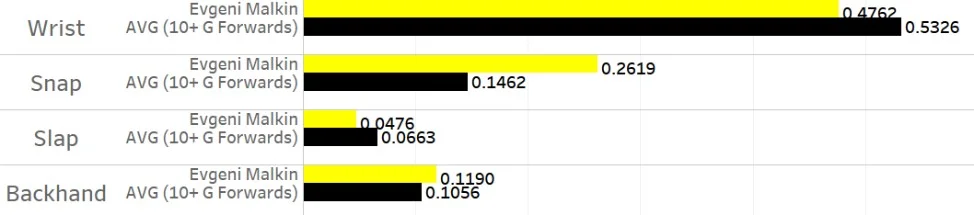
What makes Malkin dangerous is his offensive versatility; he can score from anywhere on the ice. Equal parts power and precision, Malkin possesses a variety of weapons. His snap shot goal rate clocks in at roughly double the league average (his 11 snap shot goals ranked 4th), but his middle-of-the-pack rates for wrist shots, slap shots and backhands speak to his balanced toolkit. Malkin does not rely on a single shot type to score goals, meaning that defenders must respect all shot types that Malkin credibly threatens. 

Heat Map courtesy of Micah Blake McCurdy's website HockeyViz (https://hockeyviz.com)

Heat Map courtesy of Micah Blake McCurdy's website HockeyViz (https://hockeyviz.com)

Did I mention that Malkin can score from anywhere? The sea of red is the beauty of Evgeni Malkin. He’s one of the most complete offensive players in the league. In addition to his heavy shot, his slick puck-handling ability and power forward frame allow him to generate shots and scoring chances at elite rates in the low slot area. His shot distance ranked just inside the upper third league-wide, influenced both by his crease-area chances and his shot activity in the high slot.

Malkin joins Ovechkin as the only two players in the league to finish top-10 in both even-strength goals and power play goals. He scored 28 times at evens, ranking 7th, and 14 times with the man advantage, ranking 6th. Malkin is one of the game’s most dangerous players in the offensive zone, and his goal scoring abilities rank among the NHL’s elite.

Connor McDavid

Elite Scorers 8.jpg
Elite Scorers 9.jpg

At this point, not much more needs to be said about Connor McDavid’s offensive game. His 108 points were enough for a second consecutive Art Ross (but not Hart) Trophy. He’s the been the league’s best forward for the last two years, and he’s only 21 years old.

But is he a goal scorer? While it’s true that McDavid has been viewed more as a set-up man than a finisher thus far in his young career, in 2017-18 we saw a transformation in McDavid’s offensive role. Compared to the year prior, McDavid scored 11 more goals and took 23 more shots. He became more of a trigger man, electing to attempt shots more often instead of looking to pass. This development calls to mind a young Sidney Crosby, who recorded seasons of 70 and 84 assists before breaking out for 51 goals in 2009-10.

McDavid prefers to score goals with his wrist shot. His 25 wrist shot goals ranked 3rd league-wide behind only Nathan MacKinnon and Eric Staal, while his rate of 61% ranked 9th among the 32 players who scored 30+ goals. He hardly ever takes slap shots, registering just 7 of these shots during the entire season, of which just 1 beat the goalie. Rather than rely on strength to generate power, McDavid creates offense thanks to generational skating and elite-level hands. He’s able to create and navigate space better than anyone else on the planet and puts himself into positions where a quick and accurate wrist shot is more than enough to beat the goalie.

Heat Map courtesy of Micah Blake McCurdy's website HockeyViz (https://hockeyviz.com)

Heat Map courtesy of Micah Blake McCurdy's website HockeyViz (https://hockeyviz.com)

McDavid has figured out hockey’s (not-so) secret formula: if you get close to the net, you’re more likely to score. He's extremely effective at using his speed, hands, and vision to attack the most dangerous area of the ice. McDavid’s sub-20’ average shot distance is a testament to his elite ability to generate scoring chances from the crease and low slot area.

McDavid’s special teams split is intriguing. His 35 even-strength goals ranked first in the entire NHL, but his 5 power play goals tied him for 96th among forwards. This latter can be explained both by Edmonton’s league-worst power play and also McDavid’s primary role as a puck distributor on the top unit. If Edmonton’s power play improves, which is likely given regression to the mean, McDavid’s special teams goal-scoring could very well take a step forward and supplement his elite even-strength scoring totals. He is already the game’s best forward and he poses a legitimate threat to become the game’s best scorer sooner rather than later.

Nikita Kucherov

Elite Scorers 11.jpg
Elite Scorers 12.jpg

A late 2nd round pick, Nikita Kucherov has emerged from relative anonymity to become one of the league’s most dangerous forwards. His 79 goals over the past two seasons place 3rd league-wide, and he was one of just three players to break 100 points in 2017-18.

While Kucherov’s absurdly accurate wrist shot remains his primary weapon (4th in wrist shot goals with 24), he is equally dangerous on the backhand. He scored 8 times (21% of all goals) on his backhand, ranking 2nd among 30+ goal scorers to Brad Marchand in both raw total and rate. Kucherov’s ability to score using wrist shots and backhands is all the more impressive considering that he shoots from further away than 93% of other forwards. He can be successful from this range without relying on the power of slap and snap shots due to his innate ability to find and exploit tiny gaps that goaltenders leave open. His shots are precise and accurate, and he excels at finding any available daylight.

Heat Map courtesy of Micah Blake McCurdy's website HockeyViz (https://hockeyviz.com)

Heat Map courtesy of Micah Blake McCurdy's website HockeyViz (https://hockeyviz.com)

An incredibly versatile player, Nikita Kucherov generates shots at elite rates all over the mid and high-slot. Rather than favour a specific shooting location, he elects to test the goalie from all areas of the offensive zone. This makes Kucherov unpredictable, which helps explain why his quick-release wrist shot and backhand are so devastating. He doesn’t shoot much from the crease area, but driving the net really isn’t part of how he creates offense.

Kucherov was more of a goal-scorer at even-strength than on the power play in 2017-18. He recorded 31 ES goals, one of just four players to crack 30, compared with 8 on the man advantage. He played more of a set-up role on Tampa Bay’s 3rd-ranked power play, registering 28 assists as he regularly sent cross-ice passes to Steven Stamkos (15 PP goals). Kucherov’s outstanding season cemented his status as one of the most dangerous goal scorers in the NHL, and at the prime age of 25 he’s as good a bet as any to repeat his offensive dominance next season.

Patrik Laine

Elite Scorers 14.jpg

At just 20 years old, Patrik Laine is already among the game’s premier snipers. His 44 goals ranked 2nd league-wide in 2017-18, fueling the Jets to their franchise-best season. Laine’s biggest asset is his shot, which may very well be the best in the league. Among current NHLers with 50+ career goals, Patrik Laine’s career shooting percentage of 18.0% ranks 2nd behind only Paul Byron. Byron, meanwhile, had an average shot distance of 19.3 feet in 2017-18, least of all eligible forwards, while Laine’s average shot came from 36.1 feet, ranking in the 97th percentile. The kid can shoot the puck.

Laine’s weapon of choice is his snap shot, which he routinely uses to one-time pucks into the back of the net. His quick release and accurate shot placement resulted in 14 snap shot goals in 2017-18, which tied for the league lead with Phil Kessel. He also is a fan of the slap shot, with his 6 slap shot goals placing him in a tie for 4th among all forwards.

Heat Map courtesy of Micah Blake McCurdy's website HockeyViz (https://hockeyviz.com)

Heat Map courtesy of Micah Blake McCurdy's website HockeyViz (https://hockeyviz.com)

Here we see Laine’s favourite shooting locations. A right-handed shot, Laine loves to one-time pucks from the high slot. The fact that he’s able to beat the goalie so consistently from so far away speaks to his talent as a shooter. Like Ovechkin, Laine’s shooting locations lack variety, but he’s so good from his spots that goalies have difficulty stopping the shot even if they can anticipate that it’s coming.

The triggerman for the Jets’ 5th-ranked power play, Laine lead all NHLers with 20 power play goals in 2017-18. He would routinely patrol the space between the left half-wall and left point, making himself open to cross-seam passes and one-timing his quick snapshot on net. His 24 even-strength goals tied for 20th in the league, so he’s no slouch at 5-on-5 scoring either.

Since breaking into the league, Laine has used his generational shot to pick apart opposing goalies. The odds-on favourite to inherit Ovechkin’s throne as best goal-scorer is the league, the sky’s the limit for a kid who potted 44 goals in just his second season in the league.


Conclusion

So there we have it; the modus operandi of five of the game’s elite. While Ovechkin, Malkin, McDavid, Kucherov, and Laine possess a shared gift for putting the puck in the net, they achieve it with vastly different sets of techniques, skills, and strategies. There is no uniform way to score a goal across the league, but all that matters is that it goes in.

With goals representing the currency of the NHL, goal-scorers are among the most valuable assets out there. Scoring goals wins you games, playoff series, and, as 32-year old Alex Ovechkin and 31-year-old Evgeni Malkin know, Stanley Cup championships. Kucherov (25), McDavid (21), and Laine (20) have not yet won hockey’s ultimate prize but given their relative youth and their otherworldly ability to put the puck in the net, they might not be far away.


Data courtesy of Hockey Abstract (http://hockeyabstract.com/testimonials), Natural Stat Trick (https://naturalstattrick.com), and NHL.com (https://nhl.com)

Shot heat maps courtesy of Micah Blake McCurdy’s wonderful visualization website HockeyViz (https://hockeyviz.com)

Cover photo credited to NHL.com

NHL Player Comparison Tool Guide by Guest User

By Owen Kewell and Adam Sigesmund (@Ziggy_14)

Player comparison is a popular topic of debate among armchair general managers: which guy is better? Would you rather have Player A or Player B? In the wake of a big 1:1 trade, which team won? While in the past we were left to bias, favouritism, and the infamous eye test, today we have some visualization tools to help compare players across useful metrics.

HERO Chart:

One of the best and most intuitive of these tools is the HERO Chart, as pioneered by Domenic Galamini Jr. (@MimicoHero). These charts, which are within the realm of descriptive statistics, can be found at the following website: http://ownthepuck.blogspot.ca/

Below we can see Alex Ovechkin’s HERO Chart:

Ovy.JPG

What Stats Are Measured?

HERO charts show performance across five stats: ICETIME, GOALS, FIRSTA, SHOTGEN, and SHOTSUP. ICETIME refers to all-situation (even strength, power-play, or short-handed) minutes per game. GOALS measures 5-on-5 goals per 60 minutes, while FIRSTA measures 5-on-5 first assists per 60 minutes. SHOTGEN is 5-on-5 shots generated per 60 minutes and SHOTSUP is 5-on-5 shots suppressed per 60 minutes, both relative to average. These stats are measured across the most recent three seasons, with weightings of 44%-33%-22% respectively to ultimately reach a single measure.

It’s important to note some key features of these metrics. Aside from ICETIME, the other four stats are measured only at even-strength and per 60 minutes of playing time. This serves to level the playing field, and accounts for the situation and frequency with which different players are deployed. Making these adjustments gives us a better sense of a player’s true performance, though we must consider HERO chart results in an appropriate context. Logging massive minutes and special teams scoring remain hugely important parts of the game, so they should not be disregarded when evaluating a player’s usefulness even if they are not reflected in a player’s HERO chart.

What Do the Numbers Mean?

Each of the numbers you see represents a standardized rating from 0 to 10. A rating of 5 represents league average performance at a skater’s position, with a standard deviation of 2 in either direction. For example, as we can see, Alex Ovechkin is league average at first assists compared to eligible wingers. A rating above 5 shows performance above league average, and vice versa. The scores are normally distributed with a standard deviation of 2. We can see that Ovechkin is considerably above league average at generating shots, and somewhat below league average at suppressing shots.

Can I See Someone’s Stats Over Time?

Yes you can! Just under the HERO chart you’ll find a chart showing how the player has performed over recent years. The dark blue line represents primary points per hour, and the light blue line represents shot impact per hour. Here is Ovechkin’s. We can see a slow decline, though Ovechkin remains a strong performer in both metrics.

Ovy2.JPG

How Do I Compare Players Directly?

HERO charts were largely built to perform direct comparison, so when you enter Domenic’s website you’ll see two charts beside each other. You can select players of your choice from the dropdown menu  for either chart and see a direct comparison. Let’s compare two elite centres: Sidney Crosby and Connor McDavid.

Scanning the charts, we can see that Crosby ranks higher in goals and shot generation, while McDavid ranks higher in first assists and shot suppression. Both players are fantastic across the board.

cros mc.JPG

What Else Can I Do?

In addition to comparing players to other players, we can compare players to positional archetypes. For example, we could see how Max Pacioretty stacks up compared to the average first-line winger, or how Morgan Rielly performs relative to an average #1 defenceman. Below we can see Pacioretty’s chart:

Pac.JPG

If you’re interested in learning more about how the archetypes are calculated, there’s a section labelled ‘Chart Guide’ on the website containing an explanation of the methodology. Personally, I (Owen) enjoy using archetype comparisons to evaluate acquisitions that my favourite team makes, as it gives a high-level indication of where a player could fit into a lineup. It’s also useful for convincing your friends that the young guy you’re bullish on has legitimate upside, and that your team is going to go all the way because of it.

I Have Unanswered Questions - Where Do I Go?

That’s a quick and dirty explanation of what HERO charts are and how to use them. If you have any burning questions that are unaddressed, I encourage you to read through the HERO chart FAQ’s that Domenic published. The link can be found here: https://ownthepuck.wordpress.com/2017/01/21/hero-charts-frequently-asked-questions/.

All-3-Zone Player Comparison Tools:

Eric Tulsky once said "the magic of analytics is in recording all of the small things lost to memory that add up to something significant.” The easiest events to remember after you watch a hockey game are the big events: the goals, and sometimes even the shots. What you probably don’t remember, though, are the small plays that led up to those events, and the small plays that led to nothing at all. Tulsky worked with people like Corey Sznajder (@Shutdownline) to study the events in the neutral zone that drive offense. Although Tulsky now works for the Hurricanes, Sznajder runs a massive tracking project whose numbers are brought to life by CJ Turtoro's (@CJTDevil) All-3-Zones Player Comparison Tools. Before we learn about these tools, it is important to note that Sznajder literally watches every game to collect these stats, as opposed to the data from HERO charts which are released by the league and then displayed as you saw earlier. The sample sizes in these visuals are smaller as a result, but we will see in a moment how they capture some important ways that players create value for their teams.

There are two sets of visuals, which can be found at the links below:

  1. https://public.tableau.com/profile/christopher.turtoro#!/vizhome/ZoneTransitionsper60/5v5Entries

  2. https://public.tableau.com/profile/christopher.turtoro#!/vizhome/2-yearA3ZPlayerComps/ComparisonDashboard

First, we will discuss the set of visuals you can find by clicking that first link above. Below, you will see a screenshot of one of the four visuals available at that link:

Entries.JPG

The stats displayed on this page quantify what happens when a player tries to enter the offensive zone with the puck. He can either carry it in (carry-ins/60), dump it into the zone and then chase after it (dump-ins/60), pass it off to a teammate (Entry passes/60) or fail in his attempt (fails/60).

We care about these numbers because entering the offensive zone with control of the puck is a reliable way to create offense. It is one way to quantify a small thing lost to memory that gives rise to something significant. As you can probably see from the leaderboard above, players who succeed at entering with control are better at creating offence than those who struggle to bypass opposing defenders. This is why the players here are sorted by possession entries (carry-ins + entry passes per 60 minutes).

While tracking carry-ins is a way to quantify the creation of offence, we can also use these numbers to quantify defence. Whenever a player tries to carry the puck into the offensive zone, the opposing defenders want to stop them. The best defenders in these metrics allow the fewest possession entries. The worst ones allow attackers to create offence with ease. It should not surprise you, then, that attackers try to target the defenders who struggle to defend the blue line. Defenders who allow possession entries 90% of the time they are targeted by opposing teams are obviously quite poor at defending the blue line. Below, you will see which defenders allow the fewest possession entries as a percentage of the number of times they were targeted:

Entry D.JPG

Some of the best defenders in the league show up in this leaderboard, which is further validation that what we are studying is actually important. It is always a good sign when the numbers are validated by the eye test and by years of research.

The best defensive teams either prevent zone entries altogether, or they remove the puck from the defensive zone as soon as possible. Indeed, zone exits are another way to measure defensive contributions in hockey, for both forwards and defensemen. The screenshot below shows which players succeed at removing the puck from their zone:

Exit.JPG

Again, positive contributions are measured by Possession Exits/60. Exiting with possession of the puck occurs when a player carries the puck out of the defensive zone (carries/60), or when they make a successful pass to a teammate (Exit passes/60). If a player fails to exit the zone with the puck, it is obviously a failed attempted (Fails/60). If he dumps it, clears it, or ices the puck, he is merely giving the other team another chance to create offence, which is why Possession Exits/60 ignores Dumps/60, Clears/60, and Icings/60. Exiting the defending zone with possession of the puck is obviously better than not.

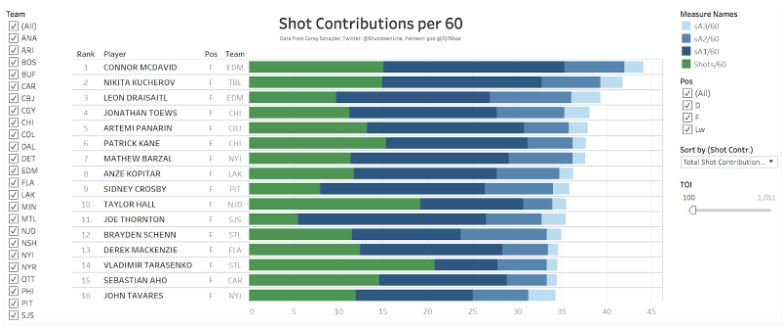
So far, we have learned how to quantify the ways players transition from the defensive zone to the neutral zone, and then into the offensive zone. All of these numbers have one underlying theme: Puck possession leads to shots. But how do we measure which players create the most shots? While the obvious answer is to count the number of shots a player takes, the tracking project takes this one step further, and counts up to three passes before each shot is taken. In the same way that points are counted as goals and assists at the player level, the tracking project keeps track of shots and the passes that precede them. The visual below illustrates how each player contributes to shots by shooting or passing:

Shot.JPG

This leaderboard ranks players by their Total Shot Contributions per 60 minutes. A player contributes to a shot if he is the shooter (Shots/60), or if he made at least one of three passes before the shot was taken. Assisting on a shot is the same as assisting on a goal, except Shot Contributions consider up to three passes before a shot while points only consider two passes. If a player made a pass immediately before the shot was taken it is called a Primary Shot Assist (sA1/60), if he made the second pass before the shot it is a Secondary Shot Assist (sA2/60), and if he made the third pass it is a Tertiary Shot Assist (sA3/60). Altogether, shot contributions are an excellent and reliable way to measure which players are creating offence.

Now that we have explored this first set of 4 visualizations, we can move on to the second part: The Player Comparison Tool. As you will see below, the Player Comparison Tool presents the numbers in a way that summarizes all of the stats we have learned about from the leaderboards. Take a look:

Subban.JPG

Most of the stats seen here should seem familiar, but this time they are aggregated to provide you with a more general snapshot of each player. For example, the Shot Contributions leaderboard we saw earlier broke down Shot Contributions into four stats: shots, primary shot assists, secondary shot assists, and tertiary shot assists. The Player Comparison Tool, summarizes these numbers to measure shooting (Shots60), passing (ShotAssists60; sA1/60 + sA2/60 + sA3/60), and total contributions (ShotContr60; Shots60 + ShotAssists60).

The zone entry leaderboard is summarized in the Entry section, using possession entries expressed as a rate stat (PossEntries60) and possession entries expressed as a percentage of total entry attempts (PossEntry%). Similarly, the zone exit leaderboard is summarized in the Exit section.

It is important to note that if you are viewing a forward using this tool, you will only see the first three sections. The fourth section, Entry Defence, is only available for defenders. This section summarizes the aforementioned Entry Defence per Target leaderboard. As discussed earlier, the best way to defend the blueline is to prevent attackers from entering the zone with control of the puck. A defender who breaks up a play at the blue line is credited with breaking up the play (Breakups60). Defenders who concede controlled zone entries less often are the ones who rank best in the second stat (PossEntriesAllowed60). This is also expressed as a percentage of the number of times the defender is the target of an attempted zone entry by the other team (PossEntry% Allowed).

You can view a players results in two 1-year windows and one 2-year window, covering the 2016-17 season and the 2017-18 season. This allows you to compare one player to himself (in consecutive seasons) or two players to each other (in the same single season or across both seasons simultaneously). As shown in the intro to analytics article, an example that motivates the study of the former is Nikita Zaitsev’s first two NHL seasons. If you are feeling extra fancy, you can also view two different players with the same name...

Aho.JPG

Although the most valid comparisons are those between players of the same position, which is obviously not true of the Sebastian Aho’s, it demonstrates one of the many ways you can be creative with these visuals once you start using them. With these tools at your disposal, you can answer silly questions like “Is Sebastian Aho better than Sebastian Aho?” along with more  objective ones such as “Who contributes to offence the most often?” and “Which defenders are best at defending the blueline?” It would be impossible to answer any of these questions without the hard work of people like Sznajder, Turtoro, Tulsky, and the mission to record mundane elements of the game that uncover hidden areas of player value.


Keep up to date with the Queen's Sports Analytics Organization. Like us on Facebook. Follow us on Twitter. For any questions or if you want to get in contact with us, email qsao@clubs.queensuca, or send us a message on Facebook.