
Author: Abdel-Rahman Mobarak

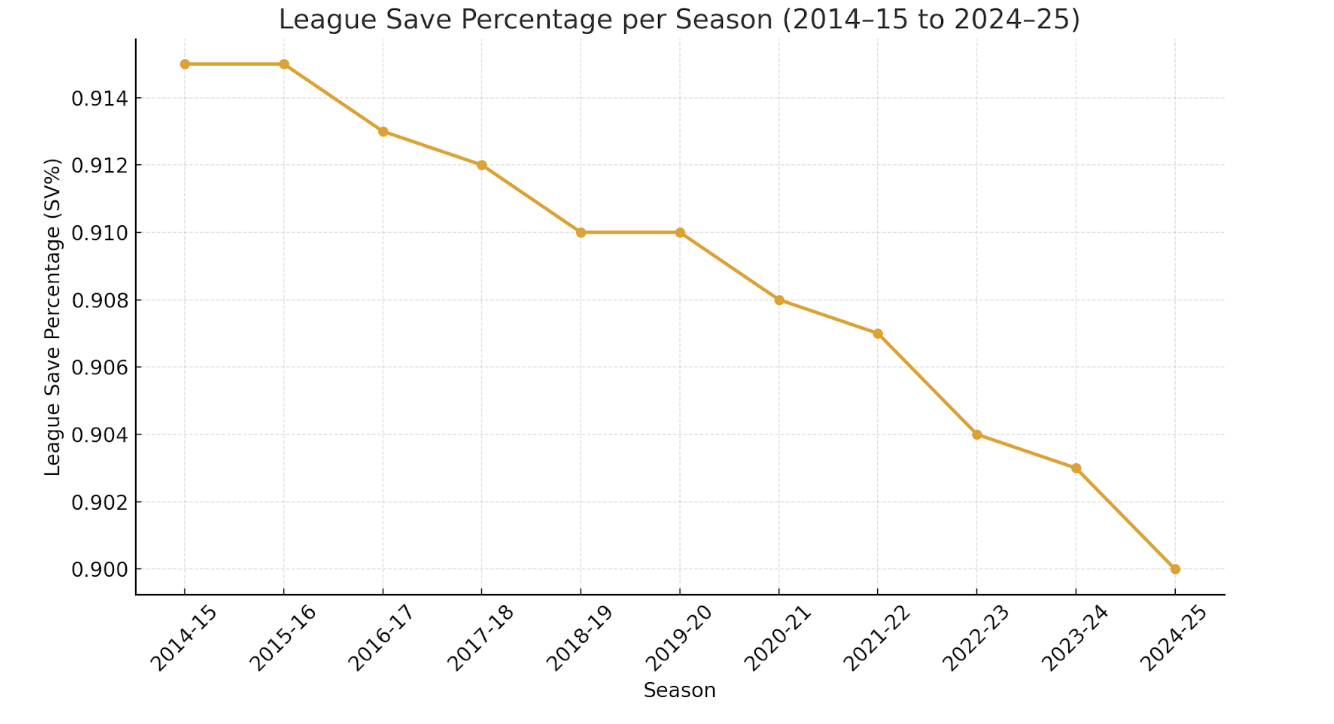
Over the last decade, we’ve seen NHL scoring creep steadily upward, while league-wide save percentage has trended in the opposite direction. Ten years ago, it was normal to see the league sitting comfortably around a .915 save percentage; today, that figure has steadily drifted toward .900. If you only look at the raw numbers, it’s easy to assume that goaltending is collapsing. However, after examining league-wide data from StatMuse, the NHL, and MoneyPuck, the story becomes far more nuanced.
Yes, save percentage is declining, but not because goaltenders suddenly forgot how to play hockey. Instead, offences have evolved, shot quality has improved, and overall talent across the league is significantly stronger than it was a decade ago. What appears to be a decline in goaltending is actually a byproduct of a league that has learned to generate and convert more dangerous chances at a historic rate.
Methods
This article will use four primary data sources:
1.Natural Stat Trick (NST)
2.StatMuse
3.Moneypuck
4.Evolving Hockey
5. Hockey Reference
Key Metrics will include:
HDCF - High-Danger Chances For
SCF - Scoring Chances FOr
xGF - Expected Goals For
SH% / SV% - Shooting and Save Percentage
GSAx - Goals Saved Above Expected
WAR - Wins Above Replacement
The League-Wide Shift in Numbers
The first metric examined was league-average save percentage by season. During the 2014–15 and 2015–16 seasons, save percentage peaked at a modern-era high of .915. By the 2024–25 season, that figure has declined to approximately .900. At a surface level, the implication is straightforward: a smaller proportion of shots are being stopped league-wide.
What’s surprising in the data is that shot volume itself has not changed significantly. League-average shots against per game have consistently fallen between 28 and 31 over the past decade and a half. Despite this stability, Hockey-Reference shows that goals per game over the last three seasons sit at approximately 3.06, a historic high not seen since the early 1990s. When years of stable shot volume are paired with rising goal totals, it becomes clear that shots are becoming more dangerous rather than more frequent.
Analytical Breakdown: How Shot Quality Improved
Once league-wide trends pointed toward improved shooting efficiency, I turned to Natural Stat Trick to examine why shot quality has increased. High-danger chances for (HDCF) provide a useful starting point, as they capture shots taken from areas where goaltenders face the greatest pressure, namely, the inner slot and the area directly in front of the net. In 2014–15, teams averaged 7.92 HDCFs per game. That figure rose to 8.14 in 2016–17, increased further to 8.60 in 2017–18, and peaked at 9.57 in 2022–23. Relative to a decade ago, this represents roughly a 15–20% increase in high-danger scoring opportunities league-wide.
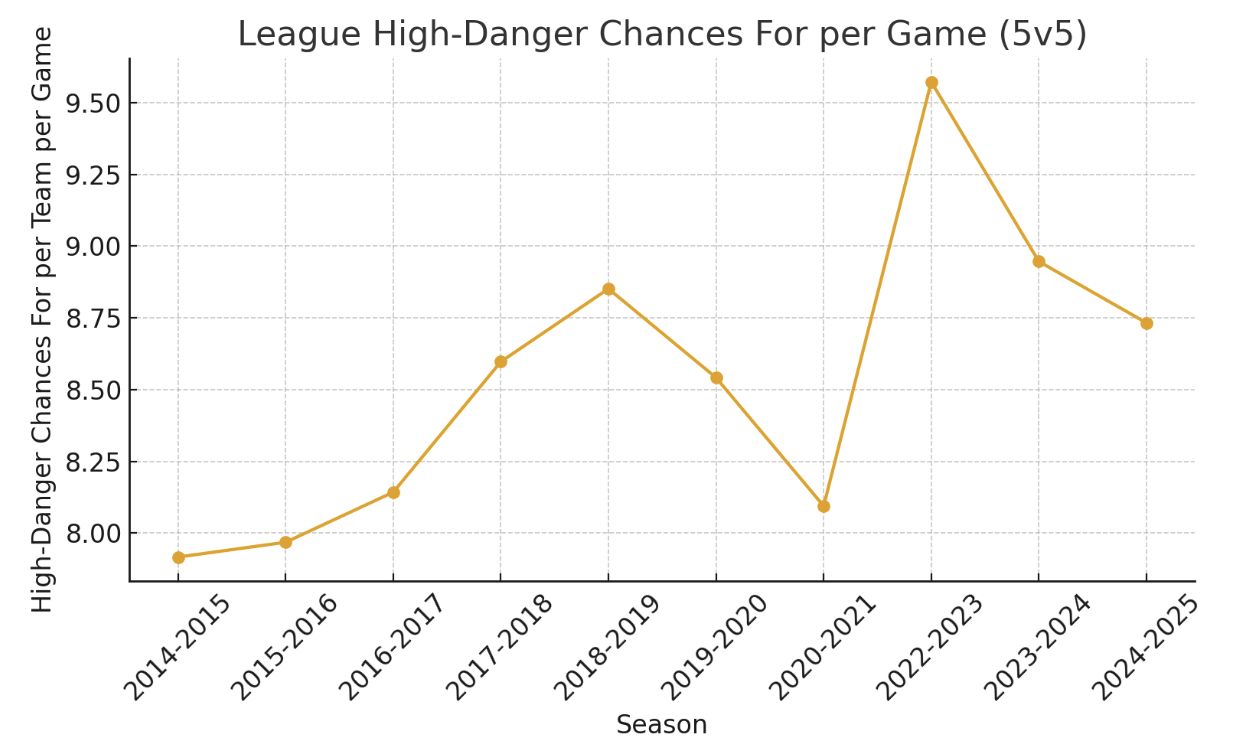
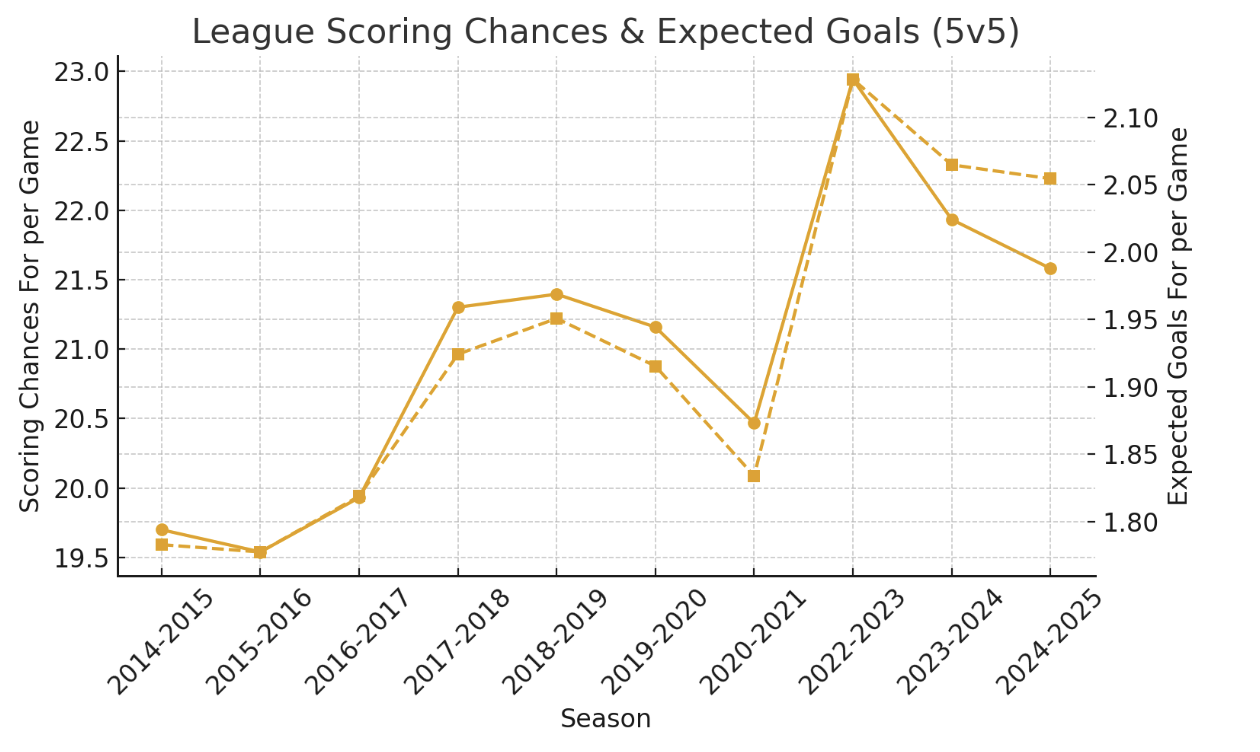
It may not seem like a lot, but high-danger looks are one of the most valuable attempts a team can create. When this growth is paired with rising scoring chances for (SCF), expected goals for (xGF), and finishing efficiency, a clearer picture emerges: teams are reaching dangerous areas more frequently and converting at higher rates. Between the 2014–15 and 2022–23 seasons, SCF% increased from 19.70 to 22.94, while shooting percentage rose from 7.97% to 9.20%. Save percentage is not declining because goaltenders have suddenly become less effective; rather, it reflects a league in which the average shot faced is meaningfully more dangerous.
Case Studies: Modern Goalies Are Still Performing at an Elite Level
Here’s the kicker: if goaltending were truly in decline, we would expect modern netminders to struggle in impact metrics such as Goals Saved Above Expected (GSAx). Instead, data from Evolving Hockey suggests the opposite: we are witnessing some of the strongest GSAx seasons on record. Consider Ilya Sorokin’s 2022–23 campaign, in which he posted a 51.36 GSAx, the second-highest total Evolving Hockey has recorded since 2007. That same season, Juuse Saros recorded a 45.49 GSAx for Nashville. Saros’ performance is particularly notable given that he ranked fifth in high-danger shots faced while also leading the league in wins above replacement (WAR), a metric that estimates a player’s value relative to a replacement-level goaltender. Notably, 50% of the ten highest single-season GSAx totals have occurred within the last three years.
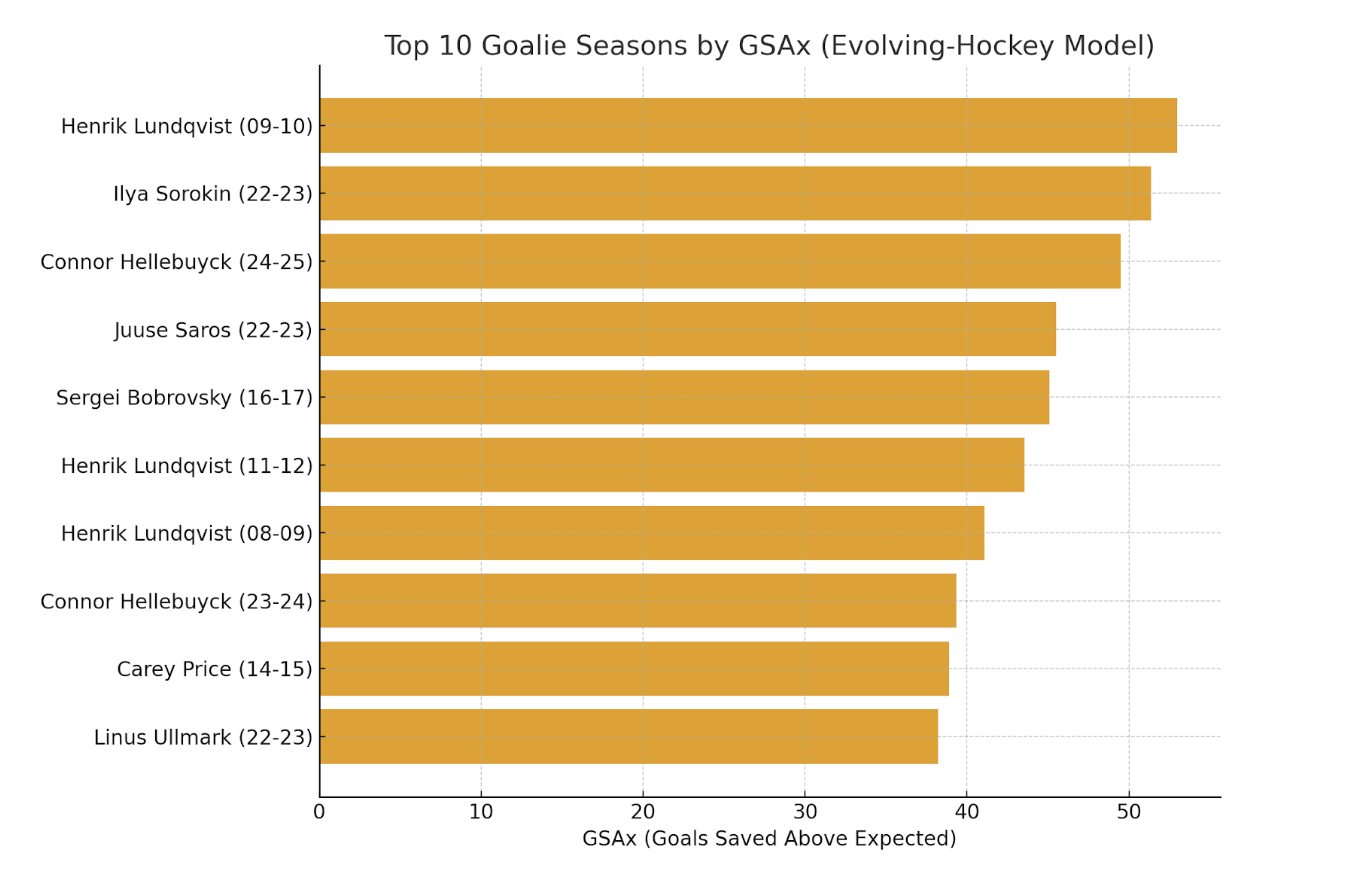
These are not the numbers you would expect from a league full of declining goaltending talent. These numbers suggest goalies are outperforming expectations by large margins. Goalkeeping remains elite, but the shots they face are more dangerous than ever.
The Goalie “Crisis” Isn’t a Goalkeeping Issue
When all of the data is considered together, the narrative becomes clear. Save percentage is not declining because of diminished goaltending quality, but because the offensive environment has fundamentally changed. While shot volume has remained relatively stable over the past decade:
High-danger chances have increased by roughly 15%
Expected goals have risen by nearly 20%
Shooting percentage has climbed from 7.97% to 9.20%
Goaltenders are producing some of the strongest GSAx seasons on record
These are not marginal shifts. They reflect a league in which offences have modernized, systems are more refined, zone entries are cleaner, puck movement is faster, shooters are more skilled, and power plays are increasingly precise. The NHL has transitioned toward a style of play that consistently turns possession into high-quality scoring opportunities.
The modern NHL is not facing a goaltending crisis; it is undergoing an offensive evolution. In that evolution, shot quality—not shot quantity—is reshaping the numbers we see today.
References
Natural Stat Trick
StatMuse
Moneypuck
Evolving Hockey